Articles
Industry news, technical articles, and product introductions
📚 Claude Tutorials Hub
40+ step-by-step Claude guides — prompt engineering, Claude Code, API, agents. Browse by topic →
Loading...
Industry news, technical articles, and product introductions
📚 Claude Tutorials Hub
40+ step-by-step Claude guides — prompt engineering, Claude Code, API, agents. Browse by topic →
Loading...
Doom Black Book author Fabien Sanglard published his agent.md on HN: stop repeating "no magic numbers" every session, write it in a file and let Claude Code inject it automatically. Full rule breakdown and a starting point for your own.
A 36GB glTF file with 1.64 billion triangles used to OOM a 192GB machine. meshoptimizer's zeux used it as a benchmark, and by fixing a memset and balancing thread load, cut processing from 9 minutes to 3.5. Here's the full breakdown and three reusable performance lessons.
MCP's official roadmap (Aug 22) sets five priority areas: agentic messaging primitives, HTTP-native transport unification, agent identity & enterprise security (DPoP + Workload Identity Federation), improved primitives, and SDK experience. What it means for developers.
Prime Intellect's NanoGPT Speedrun Frontier compares 18 frontier models across 153 autonomous runs. Fable 5 tops the board at 2,726 steps, closing 81.7% of the gap to the human record. Full leaderboard breakdown, harness analysis, and efficiency comparison.
One developer spent four months building Rust Glancer, a Rust LSP that stays under 100MB of memory — two orders of magnitude leaner than rust-analyzer, endorsed by matklad himself. The frozen-analysis-plus-on-demand-loading trade-off, the 1% vs 99% rowan debate, and who should actually switch.
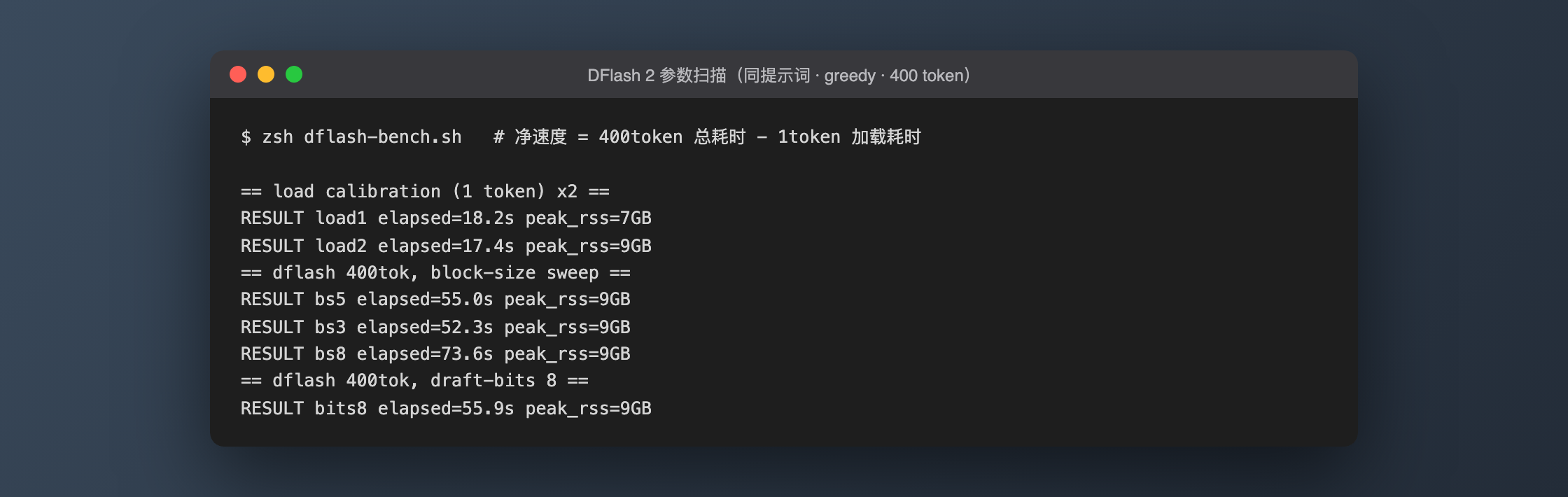
One week after DFlash 2 shipped, I got Qwen3.8-27B with speculative decoding fully working on a 24GB Mac mini M4: 6.5 tok/s to 11.7–12.2 tok/s at 4-bit, a stable 1.8–1.9x. This post covers the exact deployment commands, three controlled benchmark rounds, the GB-by-GB memory budget, and the three concrete reasons the official 2.7–3.4x number shrinks on consumer Apple Silicon. An Aug 29 retest adds a block-size and draft-precision sweep: block-size 8 collapses to 1.11x (the official cliff warning is real), block-size 3 beats the default, and an 8-bit draft loses to 4-bit.
A four-month-old alternative Rust LSP called Rust Glancer is blowing up on HN, targeting under 100MB of memory for reasonable projects — with a shoutout from rust-analyzer author matklad. Here's the core idea, the benchmark numbers, and where it actually differs from rust-analyzer.
The Model Context Protocol team published a new roadmap with five priority areas: agentic messaging primitives, HTTP-native transport unification, agent identity, improved primitives, and SDK ergonomics. Here's what each one means for your MCP integrations.
We built WeChat QR login on an Official Account, passed every local test, then hit 48001 in production. After ruling out four false suspects (IP whitelist, token cache, the console permission page, business domain), WeChat's official rid diagnosis revealed the truth: the parametric QR API only serves verified non-individual Service Accounts — a verified enterprise Subscription Account doesn't qualify, and the types can't be converted. Includes the rid/quota diagnostic toolkit and a workaround any subscription account can use: fixed QR + 6-digit code, with hand-minted NextAuth database sessions.
Our site served two regions from one database in Beijing — every query from the LA server crossed the Pacific, and pages took 2.7-4.2s. This is the full build log of a $0 fix: native MySQL binlog/GTID replication to a same-datacenter read replica, plus Prisma read/write splitting with a host-whitelist kill switch. Includes five real pitfalls with exact error messages (empty timezone tables killing replication with error 1298, RDS heartbeats that never let GTID settle, DOCKER-USER firewall rules) and clean A/B numbers from a failover drill: 3.3x faster.
Nari Labs' Qwen3-TTS synthesizes speech in under 50 ms — an order of magnitude below traditional TTS. The perceptual threshold that number crosses, why the real story is speed without more compute, where the end-to-end bottleneck moves next, and why their number isn't your number.
Someone noticed their multipoint Bluetooth headphones stopped switching back to their phone whenever an AliExpress page was open. The cause: two hidden AudioContexts with gain set to zero but still wired to the system audio destination, so the browser kept genuinely processing audio and pinned the Bluetooth path open. The investigation is worth learning from. The conclusion that traveled with it — that WebAudio fingerprinting is the next big threat — was shot down by Firefox's fingerprinting protection lead.