Was a Fruit Fly Brain Really Uploaded to a Computer? Eon's Demo, Taken Apart Layer by Layer
Was a Fruit Fly Brain Really Uploaded to a Computer? Eon's Demo, Taken Apart Layer by Layer
On March 8, 2026, San Francisco startup Eon Systems posted: "We've uploaded a fruit fly." In the video, a virtual fly follows invisible taste cues toward slices of banana, stops to groom when dust settles on it, carries on, and starts eating. For many people it was the first time they'd heard that an animal's brain could be copied into a computer.
Is that what happened? I rebuilt the system on a Mac mini from the same open-source components and read Eon's two posts and the three Nature papers behind them line by line. The short version:
- What was copied is a wiring diagram: which of the 139,255 neurons in one female fly's brain connect to which, and through how many synapses. That part is solid, published in Nature in 2024, and the data is public.
- Most of what makes it move doesn't come from that diagram. Walking, grooming and feeding movements are produced by controllers that already existed in the body model, and the mapping between brain and body was chosen by hand. Eon says so in its own technical write-up.
- The widely shared "91% behavior accuracy" is a misreading. It comes from a 2024 paper in which the model made 164 testable predictions about feeding and grooming circuits, 91% of which matched experiments. Those are circuit-level predictions, not a behavior score for the virtual fly.
Let's take it apart.
An "upload" in four layers
Eon's announcement said it used just four things: the graph of connections, weights set by synapse counts, a map of excitatory and inhibitory neurons, and a leaky integrate-and-fire (LIF) neuron model. The technical post is more complete: this was an integration of several already published pieces.
| Layer | What it is | Who built it | Openness |
|---|---|---|---|
| ① Wiring diagram | Connectome of 139,000 neurons and 54.5 million synapses | FlyWire Consortium, Nature 2024 | Data public, CC BY-NC 4.0 |
| ② Neuron model | Every neuron as an LIF unit, whole brain run in Brian2 | Shiu et al., Nature 2024 (preprint 2023) | Code MIT |
| ③ Body | A fly body modelled from an X-ray microtomography scan, 87 independent joints, running in MuJoCo | NeuroMechFly v2, Wang-Chen et al. 2024 | Apache-2.0 |
| ④ Brain–body interface | Translates a few descending neurons' firing into turning, walking, grooming and feeding commands | Eon | No public code that I could find |
A visual model (Lappalainen et al. 2024, flyvis) also turns the compound-eye image into visual-neuron activity that feeds the brain model — but Eon itself describes this part as "somewhat 'decorative'" for now, with little effect on behavior.
The first three layers are years of academic work. Eon's new contribution is mainly the fourth, plus closing the loop — senses → brain → action → new senses — synced every 15 ms.
Layer 1: where the wiring diagram comes from
The diagram comes from one adult female fly (the dataset is called FAFB, Female Adult Fly Brain). The brain was cut into thousands of ultra-thin sections, each imaged with an electron microscope; AI traced every neurite, and researchers plus citizen scientists around the world fixed the errors one by one. The Nature paper estimates about 33 person-years of manual proofreading.
The result: 139,255 neurons and 54.5 million synapses. The fly packs 7.4 synapses into every cubic micron; mammalian cortex manages under one.
I downloaded the public data and checked: the connection table has 15,091,983 rows whose synapse counts add up to 54,492,922, matching the paper (full walkthrough in How to Download the Fruit Fly Brain).
So structurally, the "copy" is real — and it is a copy of one specific, real fly's brain.
Layer 2: the neuron model that brings the diagram to life
A wiring diagram alone doesn't do anything. Shiu et al. gave every neuron the simplest possible dynamics: inputs push the membrane voltage up, it spikes at a threshold, then resets. Connection strength is just the synapse count, with the sign set by the predicted neurotransmitter. The whole model has a single free parameter: how much one synapse moves the downstream voltage.
Even this simple model predicts real circuit function. They stimulated sugar-taste neurons, let the model predict which neurons would respond and whether the motor neuron that extends the proboscis would fire, then tested those predictions on real flies with optogenetics. In the paper's words:
Across 164 predictions we were able to test empirically, 91% were consistent with our empirical results.
That's where "91%" comes from. Eon's thread says "the uploaded fly has 91% behavior accuracy", but the number measures how well the model predicts neural activity in feeding and grooming circuits when particular neurons are activated or silenced. It isn't a score for the fly walking around the virtual world, and it was measured before any body was attached.
The same paper states something else plainly:
The baseline firing of each neuron in our model is 0 Hz.
In other words, with no input, this brain is completely silent.
Layers 3 and 4: the body and the interface
NeuroMechFly's body is detailed, but the fly's "spinal cord" — the ventral nerve cord — isn't in FlyWire, and neither are the motor neurons that drive the leg muscles. Eon acknowledges this: "We can't trace the actual motor neurons because the body was not scanned."
So there's a gap between brain and body. Eon bridges it by reading only a handful of well-characterised descending neurons: DNa01 and DNa02 for turning, oDN1 for forward walking, antennal descending neurons for grooming, and motor neuron MN9 for feeding. Their firing is handed to controllers in the body model that were trained by imitation learning, and those controllers produce the actual leg movements.
The technical post offers an analogy: if you know the state of the steering wheel, accelerator and brake, you can predict what a car will do without simulating every combustion event in the engine. It's apt, and it shows the limit: in the demo, the walking is done by the body's controller; the brain decides which way to turn and whether to go or stop.
Flies have more than 1,000 descending neurons. Eon uses a few of them.
What Eon itself says
To Eon's credit, its March 10 post, "How the Eon Team Produced a Virtual Embodied Fly", is candid about the limits. A few of them:
- The behaviors "lean heavily on the body model's existing controllers", and "many of the mappings between brain and body were chosen by hand rather than derived from the connectome".
- The model's internal dynamics haven't been validated against known biological signatures such as the head-direction ring attractor or central pattern generators.
- LIF has no plasticity rules: "This fly cannot form long-term memories atm" (from the announcement thread).
- "Internal state, plasticity, learning, hormonal changes are largely missing", even though hunger, satiety, arousal, mating state and neuromodulators all reshape how a real fly responds.
- Looming stimuli activate escape-related neurons in the brain model, but "we have not yet implemented escape behavior in the body".
- The results "should not yet be interpreted as a proof that structure alone is sufficient to recover the entire behavioral repertoire of the fly".
Their position is that "upload" is a graded term, not a binary one. In their view the first fly upload was Shiu's bodiless model from 2023, and theirs is the first embodied upload, the first to close a sensorimotor loop in a simulated body.
What I saw when I rebuilt it
I assembled the same open components on a Mac mini and wrote my own layer-four interface. The full hands-on report has every number; here are the three points that matter for the "upload" question:
- Given input, the connectome computes motor signals in the right direction. After tasting sugar with its legs, the fly turns toward the food and is feeding from 0.66 s; when its compound eyes see a looming black ball, the right giant fiber fires at 1.89 s and the body backs away. The LPLC2 → giant fiber escape pathway grows entirely out of the wiring diagram.
- Given no input, it doesn't move at all. Exactly as the Shiu paper says, baseline firing is zero. A real fly in an empty box still walks, pauses and grooms; this "uploaded" brain doesn't.
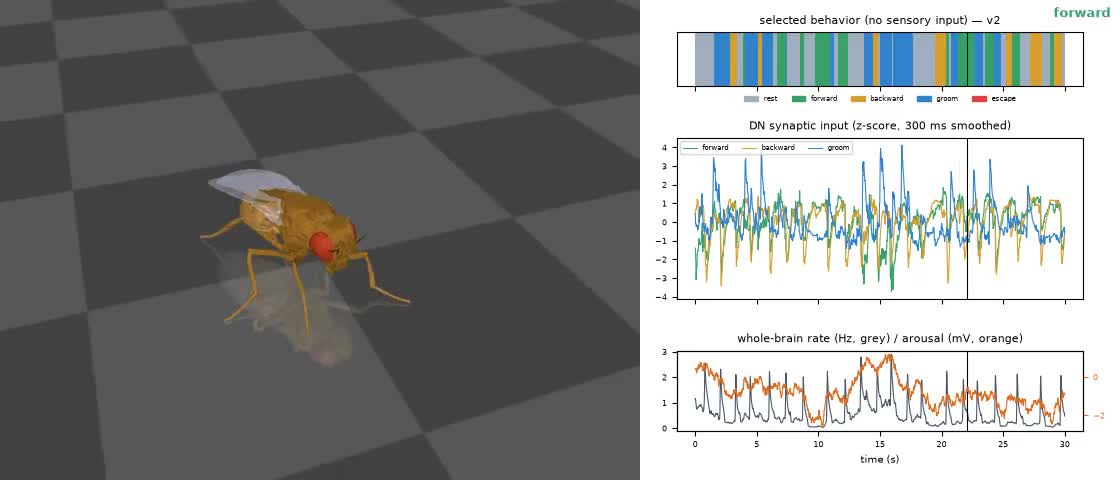
- To make it move on its own, you have to add to the equations. I added membrane noise and spike adaptation, and it began switching spontaneously between resting, walking, backing up and grooming. But the rhythm and the length of each episode are largely set by the parameters I added — change them and the behavioral statistics change.
Together these draw a clear line: the wiring diagram holds a great deal of stimulus-to-response knowledge, but a living fly's spontaneity, internal state and experience are not in it.
So, is it an "upload"?
Split "upload" into three meanings and the answer is clear:
| Meaning of "upload" | Achieved? | Basis |
|---|---|---|
| Copy the structure: move a real fly brain's wiring into a computer, as is | ✅ Yes | FlyWire: 139,255 neurons, 54.5 million synapses, public and checkable |
| Copy the function: the computer brain responds to stimuli like the real one | 🌗 Partly | 91% of testable feeding and grooming circuit predictions confirmed; no spontaneous activity, learning or internal state |
| Copy the individual: the fly in the computer is that fly, with its memories and habits | ❌ No | Synapse counts stand in for strengths; real synaptic strengths, plasticity and neuromodulation are absent, so nothing that fly learned can be read out |
A more accurate headline: scientists copied the complete wiring of one fly's brain and showed that the wiring alone holds a great deal of behavioral knowledge. That's a remarkable achievement. But "uploading an animal into a computer" has so far only taken its first step.
FAQ
Is the fly in the computer conscious?
Nobody knows. Eon says "We don't know what its experience is — nobody does", while saying it takes the possibility seriously. Looking at the model itself: it has no spontaneous activity, no memory and no internal state, and it is completely silent without input.
When will human brains be uploaded?
Not soon. A human brain has about 86 billion neurons, more than 600,000 times a fly's, and for mammals only a single cubic millimetre of mouse cortex has been mapped so far. Compute is another wall: on a Mac mini, one second of fly brain time takes over ten seconds to simulate. And as above, even a complete wiring diagram still lacks plasticity and neuromodulation.
Can I run this fruit fly brain myself?
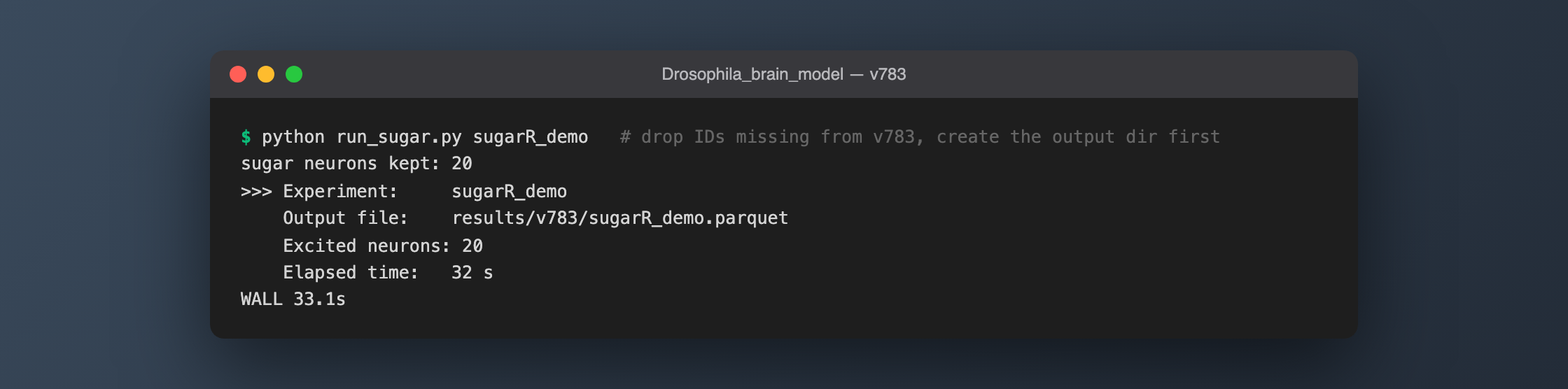
Yes, on an ordinary computer. The model code and data are public; the official example took 33 s on my Mac mini. Steps and gotchas are in How to Download the Fruit Fly Brain and Run It. If you'd rather skip the setup, drive a physics-simulated fly in your browser at the Digital Fruit Fly Lab.
References
- Eon Systems, We've Uploaded a Fruit Fly, 2026-03-08; How the Eon Team Produced a Virtual Embodied Fly, 2026-03-10 (eon.systems)
- Dorkenwald et al. 2024, Neuronal wiring diagram of an adult brain, Nature. doi:10.1038/s41586-024-07558-y
- Shiu et al. 2024, A Drosophila computational brain model reveals sensorimotor processing, Nature. doi:10.1038/s41586-024-07763-9
- Wang-Chen et al. 2024, NeuroMechFly v2: simulating embodied sensorimotor control in adult Drosophila, Nature Methods
- Lappalainen et al. 2024, Connectome-constrained networks predict neural activity across the fly visual system, Nature