Fly, Mouse, Human: How Far Is Whole Brain Emulation? The Math, Starting from a Mac mini Benchmark
Fly, Mouse, Human: How Far Is Whole Brain Emulation? The Math, Starting from a Mac mini Benchmark
After "scientists uploaded a fruit fly's brain", the next question is almost always: what about a human brain?
This article answers it concretely. It takes a whole-brain fruit fly simulation we actually ran on a Mac mini as the baseline, scales the same model and algorithm up to a mouse and a human, and looks at which walls you hit. The short version:
- Neuron counts differ by five to six orders of magnitude. A fly brain has 139,255, a mouse 70.89 million (about 500×), a human 86.1 billion (about 620,000×).
- Wall one is mapping. The largest nervous system ever mapped completely is the fly's; for mammals, only one cubic millimetre of mouse cortex has been mapped — about 1/400 of a mouse brain.
- Wall two is proofreading. Proofreading the whole fly brain took about 33 person-years. Scaled linearly, a mouse would take about 17,000.
- Wall three is compute and memory. One second of fly brain takes 12.6 s on a Mac mini; extrapolated, a mouse takes about 41 hours and 1.4 TB of memory, a human about 5.7 years and 1.7 PB.
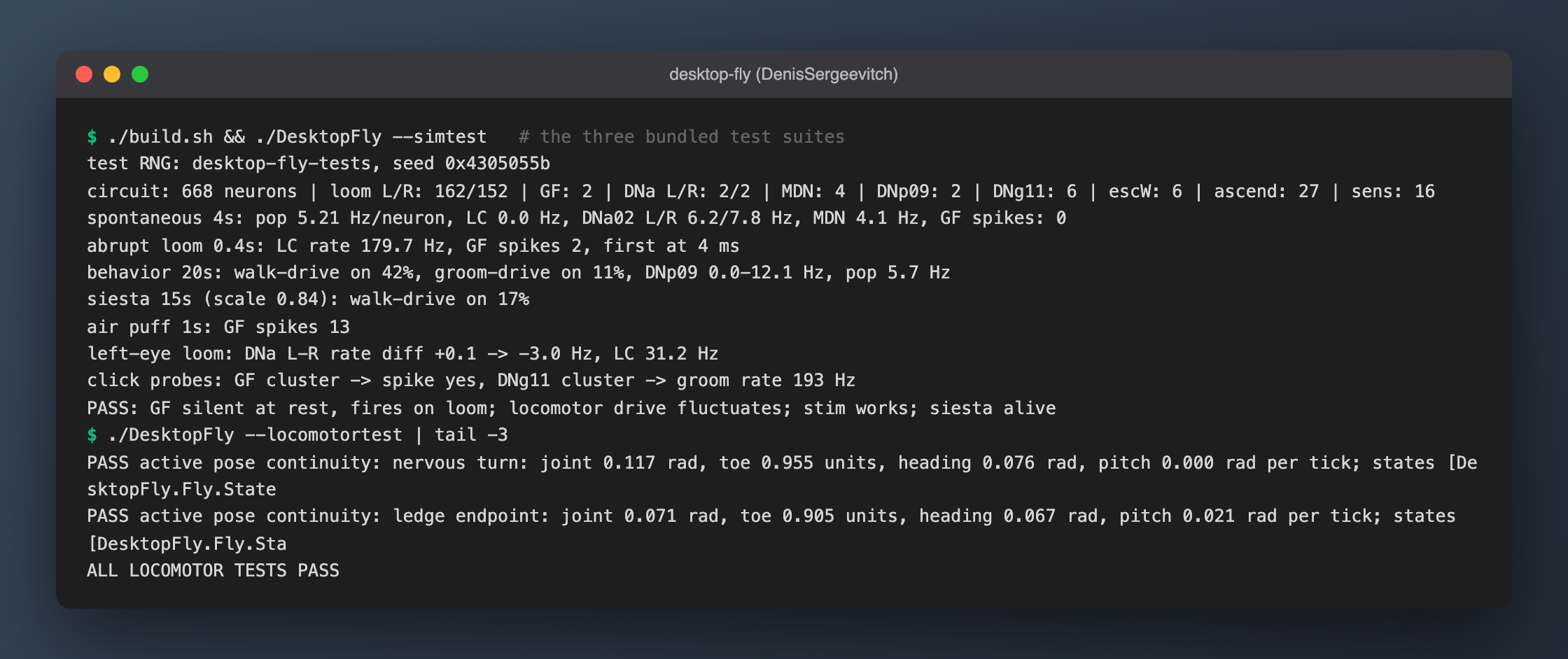
- Wall four is the most fundamental: the wiring diagram isn't enough. In our tests, the existing whole-fly-brain model fires no spikes at all without input; it has no learning, no memory and no neuromodulation.
How big are these brains?
| Species | Neurons | Complete wiring diagram | Source |
|---|---|---|---|
| C. elegans (worm) | ~300 | Mapped 1986 | Dorkenwald 2024, citing White 1986 |
| Fruit fly larva | ~3,000 | Mapped 2023 | Same, citing Winding 2023 |
| Adult fruit fly (brain) | 139,255 | 2024, FlyWire | Dorkenwald et al. 2024, Nature |
| Adult fruit fly (brain + nerve cord) | 166,700 | 2026, MaleCNS | Berg et al. 2026, Cell |
| Mouse | 70.89 million | Only 1 mm³ of cortex | Herculano-Houzel et al. 2006, PNAS |
| Human | 86.1 billion | Not begun | Azevedo et al. 2009 |
"The human brain has 100 billion neurons" is a widely repeated figure. In 2009 Azevedo et al. actually counted, using the isotropic fractionator (turning brain tissue into a uniform suspension of nuclei and counting them), and got 86.1 ± 8.1 billion.
Wall one: mapping
The first step in building a wiring diagram is imaging the whole block of tissue with an electron microscope at nanometre resolution. Here are the volumes imaged so far:
| Dataset | Imaged volume | Scale |
|---|---|---|
| Fly brain (FlyWire neuropil) | 0.0175 mm³ | 139,000 neurons |
| Fly whole CNS (MaleCNS) | 0.082 mm³ | 167,000 neurons; 7 microscopes for 13 months |
| Mouse visual cortex (MICrONS) | 1 mm³ | 200,000+ cells, ~0.5 billion synapses |
| Whole mouse brain | ~400 mm³ (brain mass 0.42 g) | 70.89 million neurons |
| Human brain | ~1.2 million mm³ | 86.1 billion neurons |
MICrONS (Nature, 2025) is one of the largest mammalian connectomes to date, yet it covers only about 1/400 of a mouse brain.
At MaleCNS's imaging rate (7 microscopes, 13 months for 0.082 mm³), a whole mouse brain would take about 5,000 years. That's a deliberately naive calculation — microscopes are getting faster, you can run more of them, and MICrONS used a different imaging pipeline — but it shows the scale: a mouse brain is about 5,000 times the volume of a fly's entire CNS.
Wall two: proofreading
Imaging is only the start. Automated AI segmentation makes two kinds of mistakes — gluing two neurons together or breaking one into pieces — and only people can fix them:
- FlyWire (fly brain): 3,013,513 manual edits, about 33 person-years.
- MaleCNS (fly whole CNS): 29 professional proofreaders over 3 years, about 44 person-years.
At the same proofreading rate, scaling linearly with neuron count, a mouse would need about 17,000 person-years and a human about 20 million.
The point of this extrapolation isn't the exact number. It's that the next bottleneck is the accuracy of AI segmentation, not microscope speed. Mammalian whole brains only become feasible if the AI makes orders of magnitude fewer mistakes.
(Details in How the Fruit Fly Brain Map Was Made.)
Wall three: compute and memory — extrapolating from a Mac mini
Baseline: how long a fly takes on a Mac mini
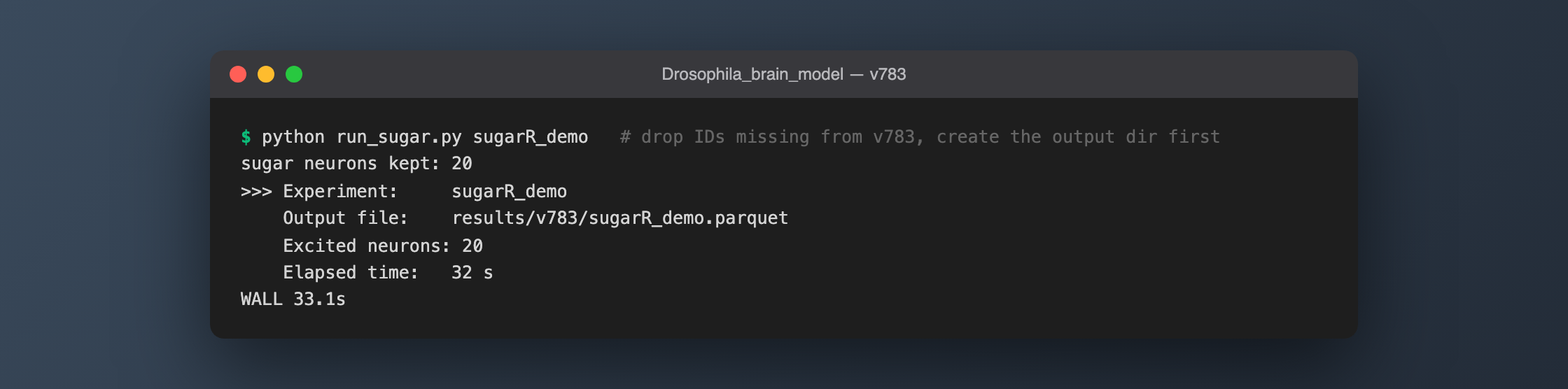
We ran the Shiu 2024 whole-fly-brain LIF model (Brian2 C++ backend) on a Mac mini M4 (10 CPU cores, 24 GB):
- Model: 138,639 neurons, 15,091,983 connections;
- 0.1 s of brain time takes 1.26 s, so 1 s of brain time takes about 12.6 s (excluding about 8 s of first-run compilation);
- The weight matrix in sparse form is about 121 MB (estimated at 8 bytes per connection).
Adding membrane noise, adaptation currents and whole-brain monitoring slows it further, to 18–24× slower than real time (see the spontaneous behavior report). Here we use the fastest figure, 12.6×, as the baseline.
Extrapolation
Assumptions:
- Compute and memory scale with the number of connections. In sparse matrix arithmetic the main cost is per connection, which roughly holds for LIF models.
- Mammalian cells have about 2,500 synapses each, from MICrONS's "200,000+ cells, ~0.5 billion synapses". Because arbors at the edge of the volume are cut off, this ratio is low; and since two mammalian neurons are usually linked by only a few synapses, synapses are used directly as connections here — close enough for an order of magnitude.
- Same neuron model, firing rates and algorithm as the fly, on the same Mac mini.
| Fly (measured) | Mouse (extrapolated) | Human (extrapolated) | |
|---|---|---|---|
| Neurons | 139,000 | 70.89 million | 86.1 billion |
| Connections | 15.09 million | ~180 billion | ~215 trillion |
| Relative to fly | 1× | ~12,000× | ~14 million× |
| Mac mini time per 1 s of brain | 12.6 s | ~41 hours | ~5.7 years |
| Weight-matrix memory | ~121 MB | ~1.4 TB | ~1.7 PB |
Look at the last row: just holding a human brain's wiring diagram in memory takes about 1.7 PB, roughly 70,000 times the 24 GB in that Mac mini. A supercomputer can stack up parallel compute, but moving spikes through a sparse matrix that large across hundreds of thousands of processors makes communication itself the bottleneck.
These are order-of-magnitude estimates, not predictions. Real cost also depends on the neuron model: LIF is the simplest; models that include dendritic morphology multiply the compute by several more orders of magnitude.
Wall four: a wiring diagram isn't a brain
The first three walls are engineering problems that technology will eventually knock down. The fourth is different.
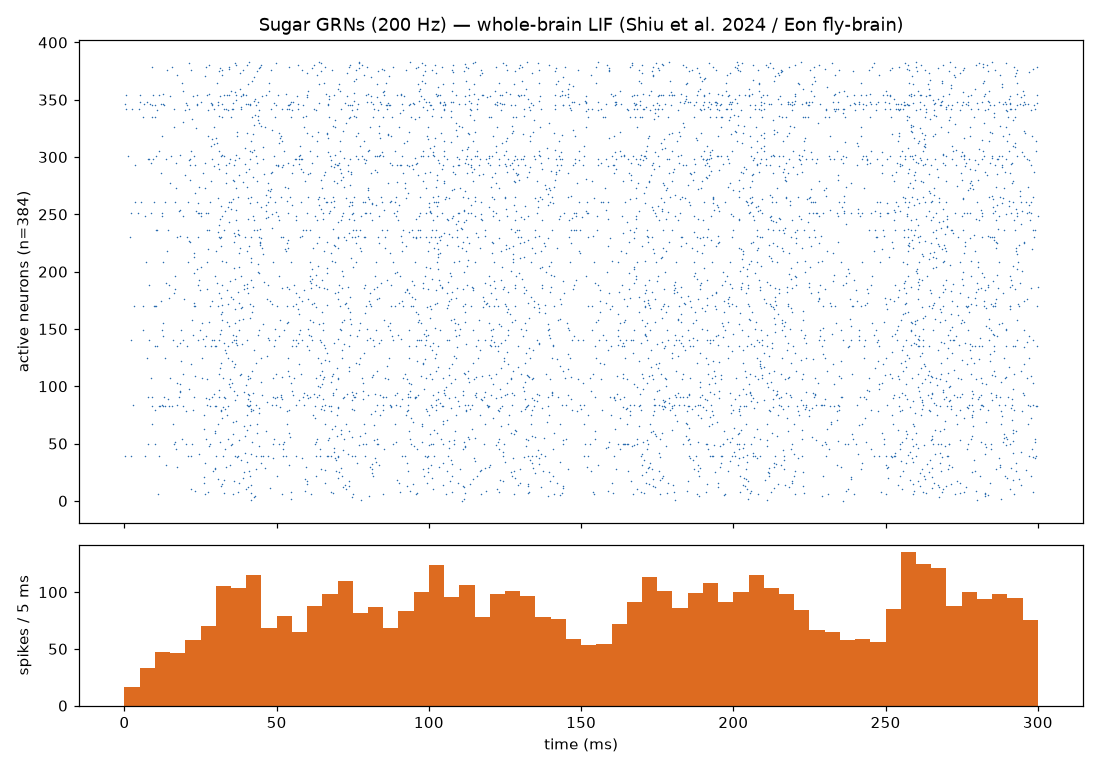
We tested the same whole-fly-brain model: with no input, it fires not a single spike. That matches the Shiu et al. paper, which states that each neuron's baseline firing rate is 0 Hz. A real fly in an empty box walks, pauses and grooms; this "rebuilt" brain doesn't. Only after we added membrane noise and spike adaptation did it start moving on its own — and its rhythm and episode lengths were largely set by the parameters we added.
Plenty more is missing, as Eon Systems acknowledges in its own technical write-up:
- No plasticity: the LIF model has no learning rules, and "this fly cannot form long-term memories";
- No internal state: hunger, satiety, arousal, mating state and neuromodulators all reshape a real fly's responses, and are largely absent;
- Connection strengths are guesses: synapse counts stand in for true synaptic strength, and signs come from AI-predicted neurotransmitters;
- Nothing below the neck: FlyWire has only the brain, so the path to the motor neurons has to be hand-written (MaleCNS adds the ventral nerve cord).
So even if a human wiring diagram were someday complete and the compute were there, an "upload" would be simplified dynamics running on a structural map — still missing learning, memory and chemical state, which nobody yet knows how to measure. (See Was a Fruit Fly Brain Really Uploaded?.)
So what is the fly good for?
Whole-brain simulation already does useful work in the fly. Using this LIF model with a single free parameter, Shiu et al. made 164 experimentally testable predictions about feeding and grooming circuits, and 91% matched the experiments. When we ran the official model ourselves and silenced one neuron at a time, we also found a descending neuron that the model predicts "brakes" feeding (see How to Download the Fruit Fly Brain).
The fly is the first test bed large enough to matter yet small enough to map completely. Working out on it how much behavior a wiring diagram explains — and what's missing — is far more practical than leaping straight to the human brain.
FAQ
How many neurons does a fruit fly brain have?
FlyWire counts 139,255 in the adult female brain (including the optic lobes); MaleCNS counts 166,700 in the male's entire central nervous system (brain plus ventral nerve cord). The Shiu 2024 whole-brain model uses 138,639.
What is whole brain emulation?
Scanning a brain's complete structure, then rebuilding and running its dynamics in a computer so it functions like the original. The idea was laid out systematically in Sandberg and Bostrom's 2008 report Whole Brain Emulation: A Roadmap. The fruit fly is the animal closest to that goal today, but as above, only the structural layer has been achieved.
When will human brains be uploaded?
There's no reliable timeline. On this accounting, mapping, proofreading and compute are each short by several orders of magnitude, and for the fourth wall — measuring learning, memory and chemical state — there's no workable method yet.
Can I run a whole-fly-brain simulation myself?
Yes. The official model and data are public and run on an ordinary computer; see How to Download the Fruit Fly Brain and Run It. Or start by driving a physics-simulated fly in your browser at the Digital Fruit Fly Lab.
References
- Dorkenwald et al. 2024, Neuronal wiring diagram of an adult brain, Nature. doi:10.1038/s41586-024-07558-y
- Berg et al. 2026, Sexual dimorphism in the complete Drosophila male central nervous system connectome, Cell. doi:10.1016/j.cell.2026.08.015
- MICrONS Consortium 2025, Functional connectomics spanning multiple areas of mouse visual cortex, Nature. doi:10.1038/s41586-025-08790-w
- Herculano-Houzel, Mota & Lent 2006, Cellular scaling rules for rodent brains, PNAS. doi:10.1073/pnas.0604911103
- Azevedo et al. 2009, Equal numbers of neuronal and nonneuronal cells make the human brain an isometrically scaled-up primate brain, J. Comp. Neurol. doi:10.1002/cne.21974
- Shiu et al. 2024, A Drosophila computational brain model reveals sensorimotor processing, Nature. doi:10.1038/s41586-024-07763-9
- Sandberg & Bostrom 2008, Whole Brain Emulation: A Roadmap, Future of Humanity Institute