Articles
Industry news, technical articles, and product introductions
📚 Claude Tutorials Hub
40+ step-by-step Claude guides — prompt engineering, Claude Code, API, agents. Browse by topic →
Loading...
Industry news, technical articles, and product introductions
📚 Claude Tutorials Hub
40+ step-by-step Claude guides — prompt engineering, Claude Code, API, agents. Browse by topic →
Loading...
Claude Code auto mode pops up 'temporarily unavailable, so auto mode cannot determine the safety of bash'? First, the conclusion: it's not your command that's dangerous; it's the safety classifier (an additional model call) that's temporarily unavailable. This article provides a four-step fix, a complete variant lookup for model name × tool name × reason, and a mechanism explanation for why read-only operations are unaffected.
GitHub made Stacked PR a native feature and opened public preview on July 30, 2026: split a large change into a series of stacked small PRs, review layer by layer, and merge the entire stack with one click. This article is based on the official changelog and gh-stack documentation: five-minute quickstart (init/add/push/submit), review and merge rules (can you merge only one?), how to convert existing branches into a stack, daily maintenance with rebase/sync, and answers to frequent questions like pricing and Windows support.
What models can a Mac mini with 24GB unified memory actually run? The answer: 27B with 4-bit quantization is the ceiling, and we successfully ran Qwen3.8-27B on the base M4 Mac mini—peak memory 19.4GB, 11.7-12.2 tok/s with speculative decoding. This article summarizes all measurements on this machine: memory budgets for various model sizes, speed expectations, real effects of three acceleration methods (DFlash 2 / native MTP / MLX vs llama.cpp), and how to choose quantization levels.
Does 4-bit quantization make models stupid? Can Q3 still be used? This article is based on llama.cpp official measured data for Llama-3-8B's full quantization levels, explaining the precision loss for each level from Q8_0 to IQ1_S, providing a specific selection path of 'choose the highest level that fits in memory', and answering common questions like how much difference between Q4 and Q8, what imatrix is for, and what 1.58-bit is about.
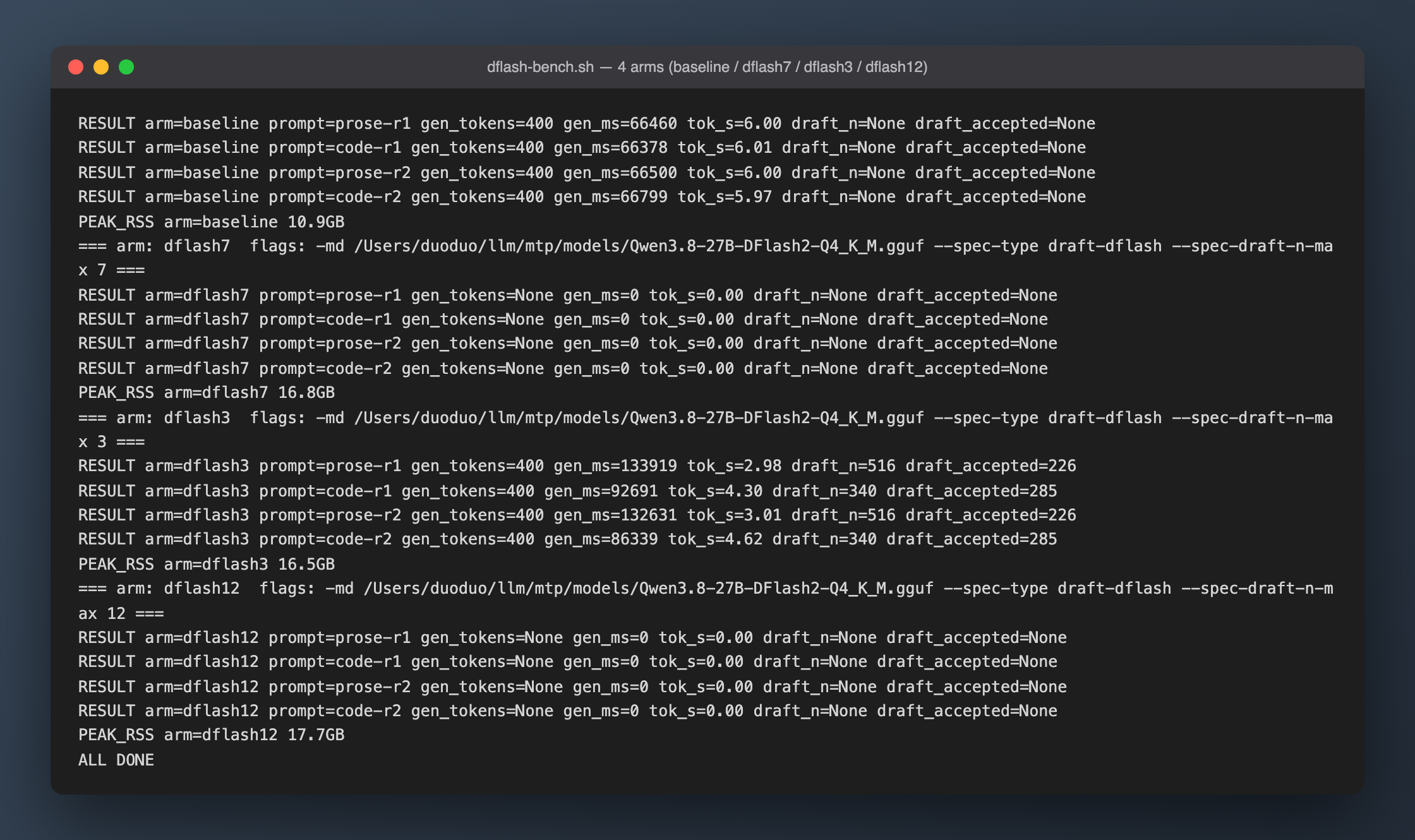
Part three of my speculative-decoding trilogy on a base Mac mini M4. llama.cpp merged DFlash 2 support with official GGUF drafts — and every configuration is a net slowdown. The README-recommended n-max 7 hits a reproducible Metal OOM on 24GB; the only stable setting cuts prose from 6.0 to 3.0 tok/s, and an 83.8% acceptance rate on code still loses 23%. Same algorithm, same machine, MLX gets 1.8–1.9x. The arithmetic shows why: 0.77s per speculative step loses even at 100% acceptance.
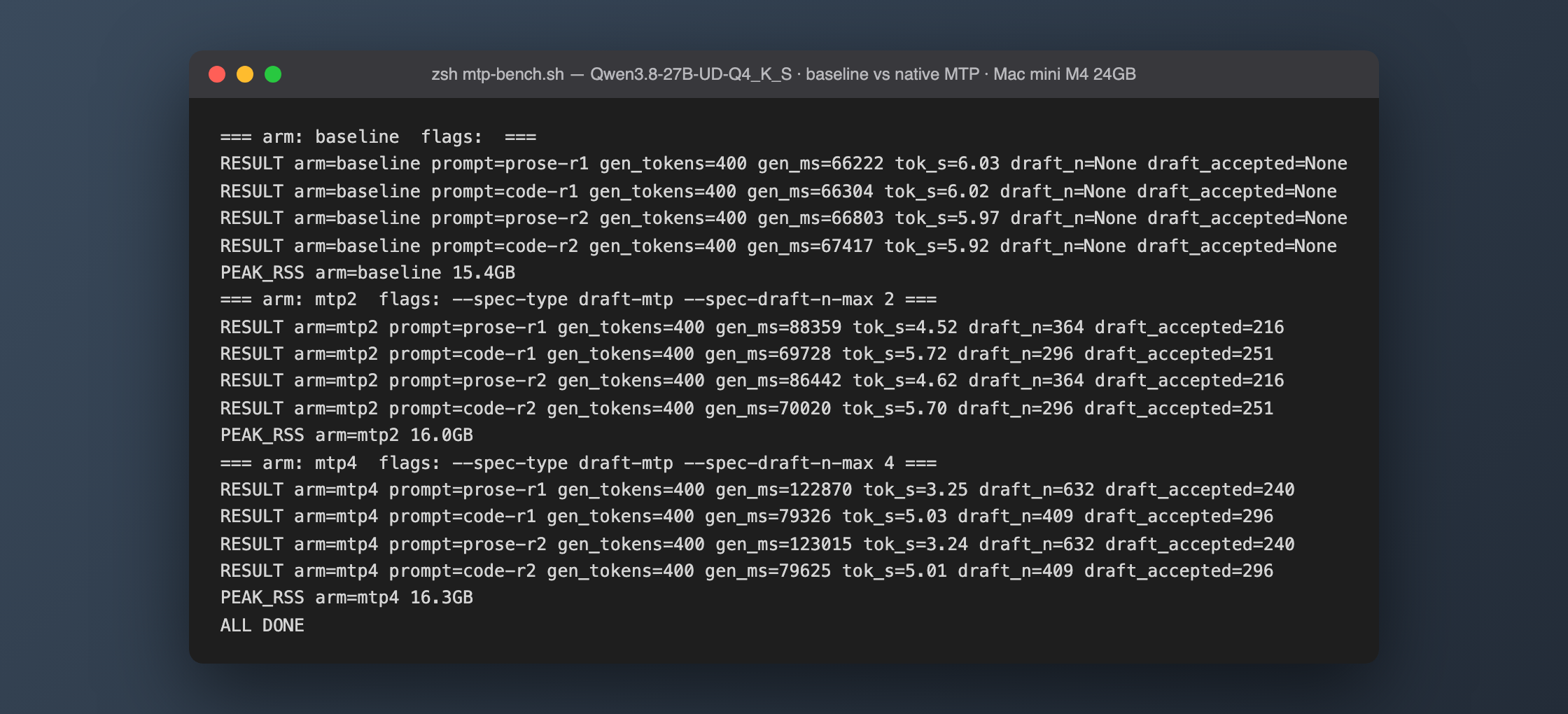
Qwen3.8 ships a trained multi-token-prediction head, and llama.cpp can mount it with one flag — no separate 2B draft model. I benchmarked it against DFlash 2 on the same 24GB Mac mini M4: memory does drop (16.0GB vs 19.4GB peak), but speed goes backwards — prose falls from 6.0 to 4.5 tok/s (-24%) while DFlash 2 delivers 1.8–1.9x on the same machine. Draft acceptance is healthy (59–85%); the loss is in Metal's verify path — batch-8 decode amortizes at just 1.13x, measured.
A production pipeline went dark two mornings in a row: logs stopped at 07:04, and every poll after that said 'record exists for today, skipping.' The root cause was PM2's cron_restart on a wake-every-5-minutes dispatcher — it kills the running instance (and its children) before starting a new one. Includes an 8-minute local reproduction: the cron_restart group started 9 times and finished 0; the resident-loop control finished 4 out of 4.
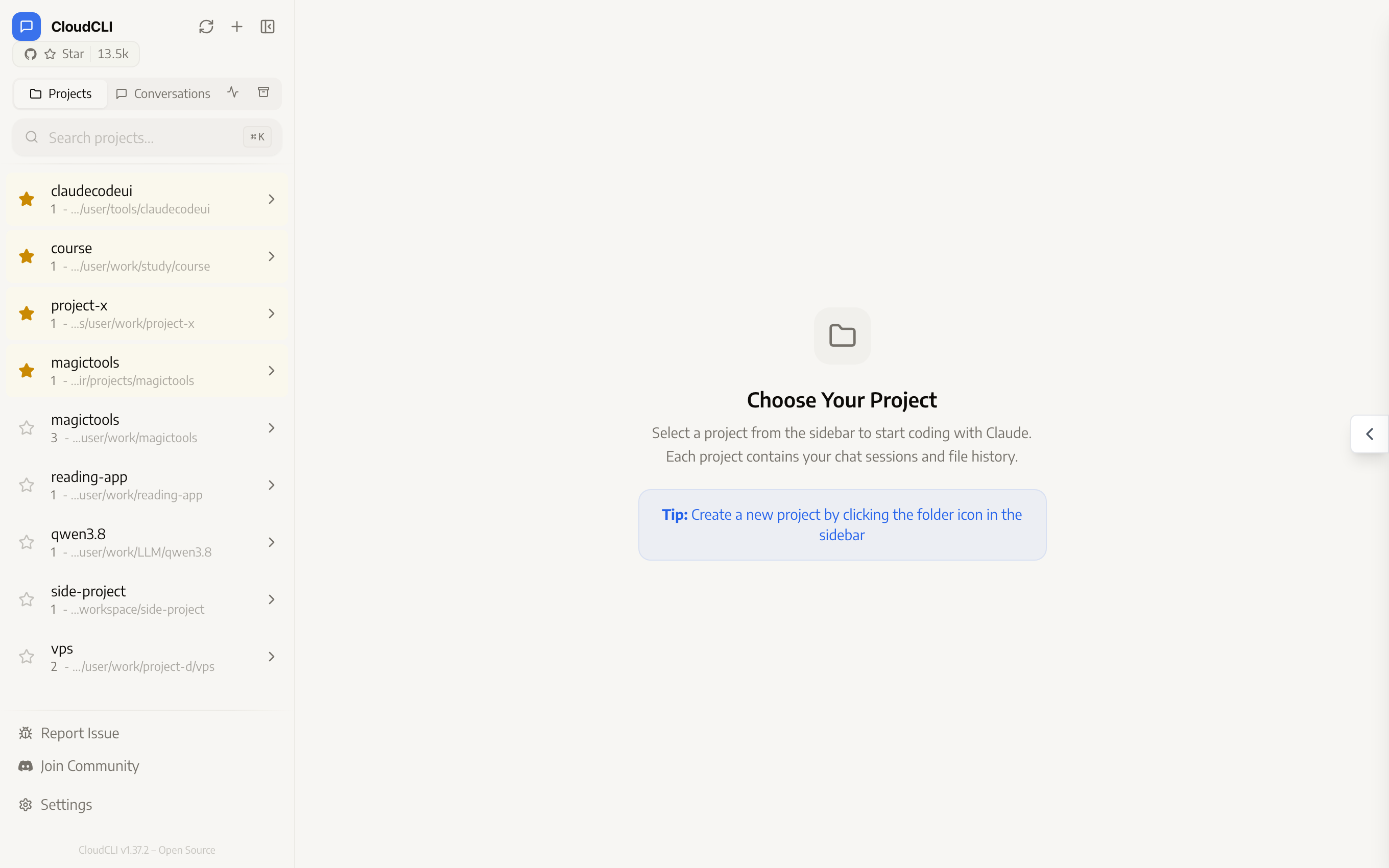
A Mac mini at home runs Claude Code around the clock — but how do you take over a session from a browser when you're away? This is a real setup that has been live for a week and in daily use: claudecodeui as the web UI (chosen over the official web version, ttyd, and code-server), an SSH reverse tunnel pushing it to a VPS, and nginx adding TLS plus login rate limiting to turn it into an ordinary URL. Includes full configs, real operating numbers (five days of tunnel uptime with zero drops, 170MB RSS), a <synthetic> placeholder bug hit and fixed within the first week, and an honest for-and-against on why not Tailscale.
Kern squeezes the entire container and resource runtime into a 1.5MB single binary with no resident daemon. Here's the daemon-less process model, what 1.5MB actually buys you, why this is a decade of evolution since Docker, and why you shouldn't migrate yet.
Full recap of the Aug 24 Claude API outage: elevated errors from 04:50–07:36 UTC across Claude Mythos 5, Fable 5, Opus 5 and Opus 4.8, hitting claude.ai, the API, Claude Code and Cowork. Includes the verbatim status-page timeline and tips for developers.
An open-source router stacks 34 free LLM tiers into one OpenAI-compatible endpoint, unlocking ~7.4B tokens/month. Here's how freellmapi routes requests, why it's turning free into a business, and four caveats before you trust it in production — plus a note on Claude's new plugin marketplace.
I exported ANTHROPIC_BASE_URL in .zshrc to point at a self-hosted API gateway, and Claude Code kept talking to Google Vertex anyway. On the same machine, a launchd-managed web UI insisted it wasn't authenticated at all. Neither bug was in the gateway — both were in the gap between 'I set the env var' and 'the process actually has it.'