Articles
Industry news, technical articles, and product introductions
📚 Claude Tutorials Hub
40+ step-by-step Claude guides — prompt engineering, Claude Code, API, agents. Browse by topic →
Loading...
Industry news, technical articles, and product introductions
📚 Claude Tutorials Hub
40+ step-by-step Claude guides — prompt engineering, Claude Code, API, agents. Browse by topic →
Loading...
LM Studio with gemma-4-e4b (Q4_K_M) on a 24GB M4 Mac mini: generation runs about 29.5 tok/s, and turning GPU offload from max to off costs only 11%. What really feels slow is prompt prefill — a 13K-token prompt waited 39.4 seconds for the first token (about 330 tokens/s), and 3.4–3.7x longer on CPU. A second request with the same prefix got its first token in 0.1 s thanks to prefix caching. With --parallel 4 and four simultaneous requests, each dropped to 9.7 tok/s.
On a 24GB M4 Mac mini, Ollama 0.19 sees only 17.8 GiB of VRAM and defaults to a 4096-token context. With qwen3:4b, going from 4k to 32k context grows memory from 3.73GB to 9.89GB; OLLAMA_NUM_PARALLEL=4 at 8k uses exactly as much as a single 32k slot while ollama ps still shows 8192; Flash Attention + q4_0 KV cache brings 32k down to 4.31GB and 64k to 5.77GB with no speed loss. Ask for a context far beyond RAM and Ollama doesn't refuse — it starts allocating, and free memory fell to 23% within 16 seconds. Running fully on CPU was only 25% slower.
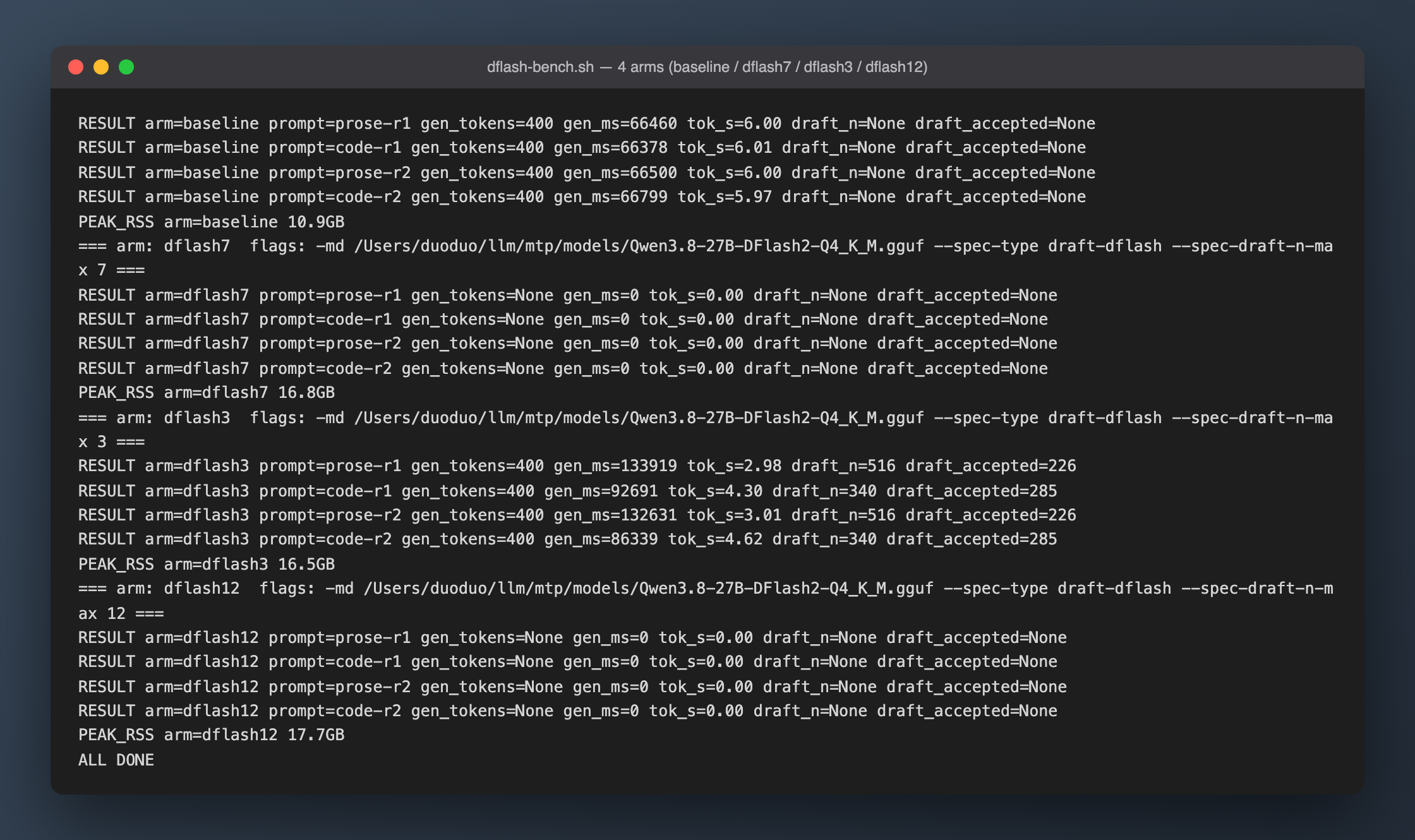
Part three of my speculative-decoding trilogy on a base Mac mini M4. llama.cpp merged DFlash 2 support with official GGUF drafts — and every configuration is a net slowdown. The README-recommended n-max 7 hits a reproducible Metal OOM on 24GB; the only stable setting cuts prose from 6.0 to 3.0 tok/s, and an 83.8% acceptance rate on code still loses 23%. Same algorithm, same machine, MLX gets 1.8–1.9x. The arithmetic shows why: 0.77s per speculative step loses even at 100% acceptance.
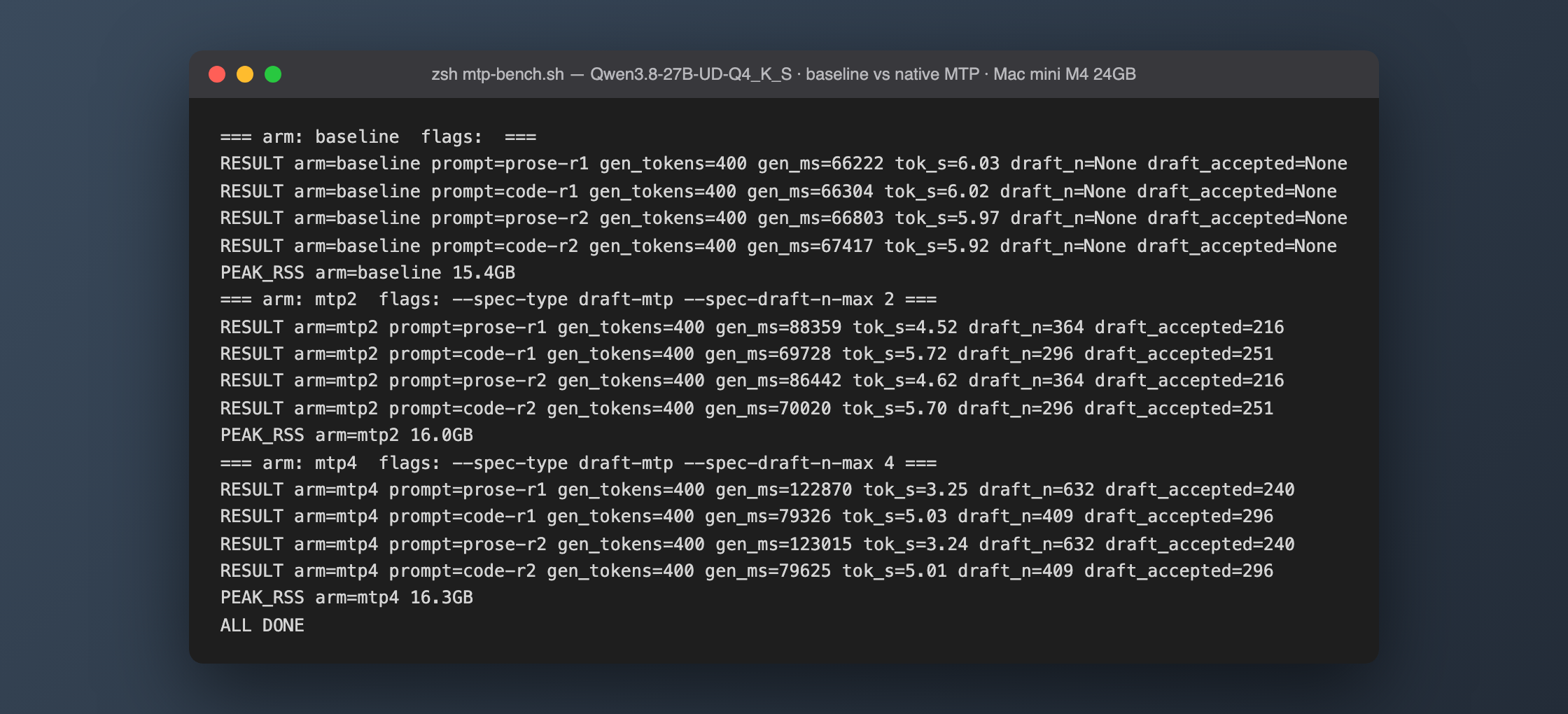
Qwen3.8 ships a trained multi-token-prediction head, and llama.cpp can mount it with one flag — no separate 2B draft model. I benchmarked it against DFlash 2 on the same 24GB Mac mini M4: memory does drop (16.0GB vs 19.4GB peak), but speed goes backwards — prose falls from 6.0 to 4.5 tok/s (-24%) while DFlash 2 delivers 1.8–1.9x on the same machine. Draft acceptance is healthy (59–85%); the loss is in Metal's verify path — batch-8 decode amortizes at just 1.13x, measured.
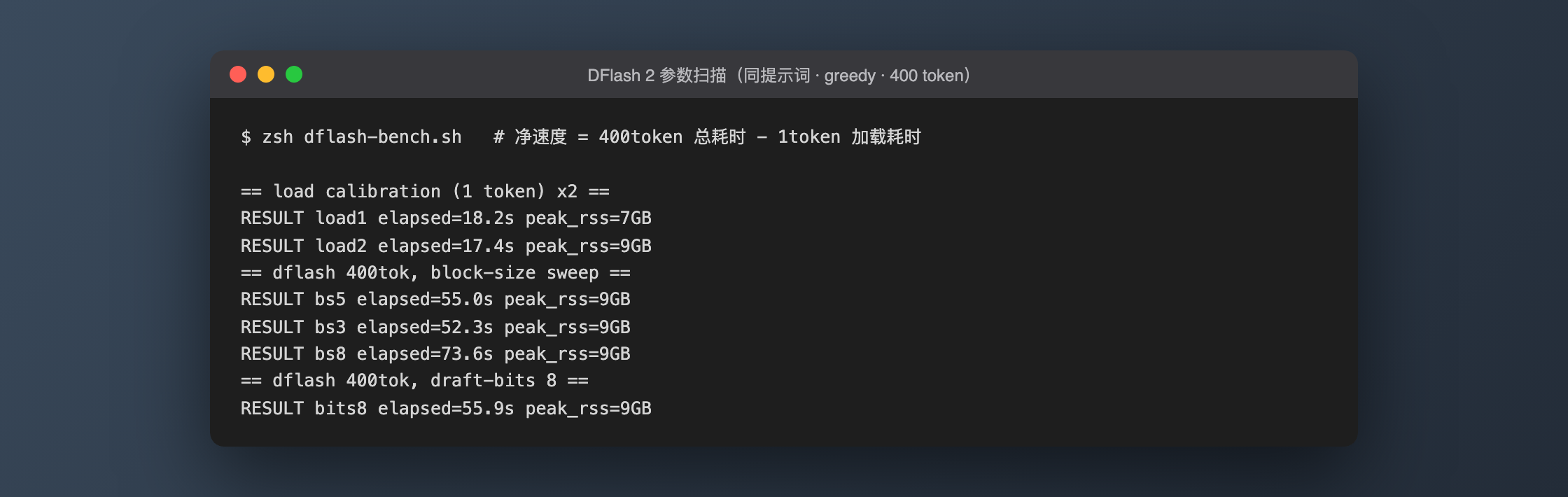
One week after DFlash 2 shipped, I got Qwen3.8-27B with speculative decoding fully working on a 24GB Mac mini M4: 6.5 tok/s to 11.7–12.2 tok/s at 4-bit, a stable 1.8–1.9x. This post covers the exact deployment commands, three controlled benchmark rounds, the GB-by-GB memory budget, and the three concrete reasons the official 2.7–3.4x number shrinks on consumer Apple Silicon. An Aug 29 retest adds a block-size and draft-precision sweep: block-size 8 collapses to 1.11x (the official cliff warning is real), block-size 3 beats the default, and an 8-bit draft loses to 4-bit.