Magic Tools
Developer ToolsBy CooconAugust 15, 2026202 views3 min read

Qwen3.8-27B Is Out. Don't Rush to Swap Your Main Model.

Qwen3.8-27B Is Out. Don't Rush to Swap Your Main Model.

A friend dropped a link in our group chat last night: Qwen3.8-27B, open source, with GGUF quants and FP8 weights live on day one. His exact words: "Dude, it just runs."

He wasn't exaggerating. The HuggingFace repo has the original weights, the FP8 build, and the GGUF quants sitting side by side. No conversion scripts, no waiting on the community to patch formats. You download it, you feed it to Ollama, you're done. For anyone running local models, that's not a few saved steps — it's an entire afternoon of "why won't this thing start" that you get back.

But the more a model feels like it works out of the box, the more you should ask: is it actually worth swapping now?

27B Is the Sweet Spot Nobody Talks About

Size first. 7B is too small to do real work. 70B won't fit on a single 4090. 27B sits right in the middle — the upper limit of what an individual developer can realistically run.

It beats 7B by more than a notch, and it demands far less than 70B. If you were running Llama 3.1 8B yesterday, you can slide over to 27B today. Inference might run 2–3× slower, but the capability jump is more than a full tier.

That's not me being generous — laid out side by side, 27B is the most cost-effective local model upgrade of the year. The only real question is whether it fits on your card.

FP8 Is Not a Free Lunch

The official promo has one line you should push back on: performance that "completely dominates." Check which benchmarks that claim comes from before you believe it.

FP8 is a compressed format. It loses real precision. Faster inference, at the cost of output quality. This is not new — when Llama 3.1 405B shipped, the community ran it in FP8 and hallucination went up. Quantized models are fine when you want fast, rough, and cheap. For actual coding or fine-tuning, stick to the original weights.

Put simply: GGUF is built for llama.cpp and Ollama toolchains. It saves VRAM. Every gigabyte it saves, it carves out of precision.

Don't Let "Works Out of the Box" Cloud Your Judgment

My advice, in three steps:

  1. Don't swap your main model yet.
  2. Load the GGUF build in Ollama and run your usual 10 prompts through it.
  3. Compare FP8 against FP16 output. See if the difference is acceptable.

If it is, switch. If it isn't, wait for the original weights or a more mature quantization.

A model's reputation doesn't count. What your prompts produce counts.

What You Can Do Today

  • Pull Qwen3.8-27B-GGUF from HuggingFace and get it running once in Ollama.
  • Take a code-gen or summarization task you actually use, and compare FP8 output against the original.
  • Write down your GPU and VRAM. Do the math on whether 27B fits before you download — not after.

Don't upgrade first. Test first. Then decide.

✨ Drafted by DeepSeek, reviewed and polished by Claude.

Sources:
Related Articles

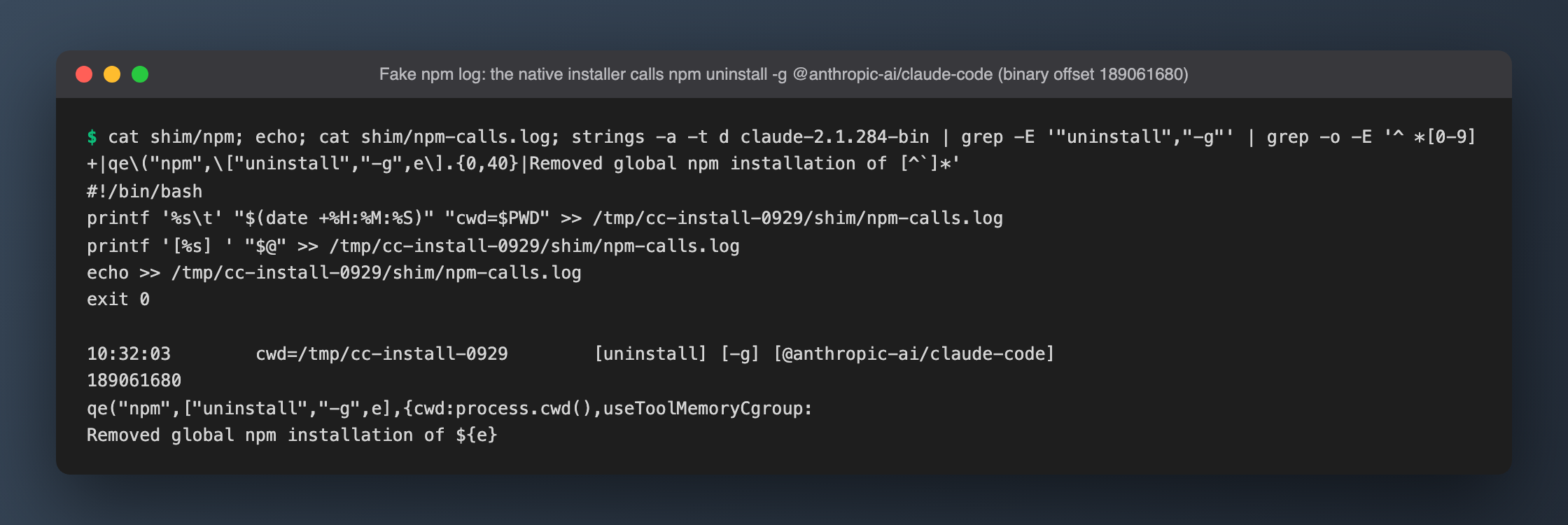
Claude Code install errors, reproduced: EACCES, a 600s mirror stall, Node 20 silently getting an old version, a region-block install.sh, and the native installer removing your npm copy

Claude Code install errors, reproduced: EACCES, a 600s mirror stall, Node 20 silently getting an old version, a region-block install.sh, and the native installer removing your npm copy

I reproduced every Claude Code install failure I could on macOS: 15 verbatim errors, each with wall time and exit code. npm -g into /usr/local fails with EACCES, exit 243. A cache dir that is merely 0555 gets blamed on root-owned files, with sudo chown advice. From Beijing, npmmirror took 147s and then >600s, npmjs 11-12s (2 samples each). On Node 20, an unpinned install silently lands on 2.1.197. Fetching claude.ai/install.sh from a blocked region gives curl exit 0 and a 447 KB HTML page. The native installer runs npm uninstall -g on your npm copy without saying so; it removed mine.

claude-codetroubleshooting+5
pitfallsSep 29, 202611 min
15

Dev Breakfast · 2026-09-29

Today's headline: Adding 'Do not guess' cuts hallucination rate from 71% to 20%. Plus 4 more: Go's import path tied to GitHub: how much code changes when switching hosting; Sonnet 5.5 released: Terminal-Bench jumps from 10.3% to 70.6%; and more.

daily-intelSep 29, 20267 min
119
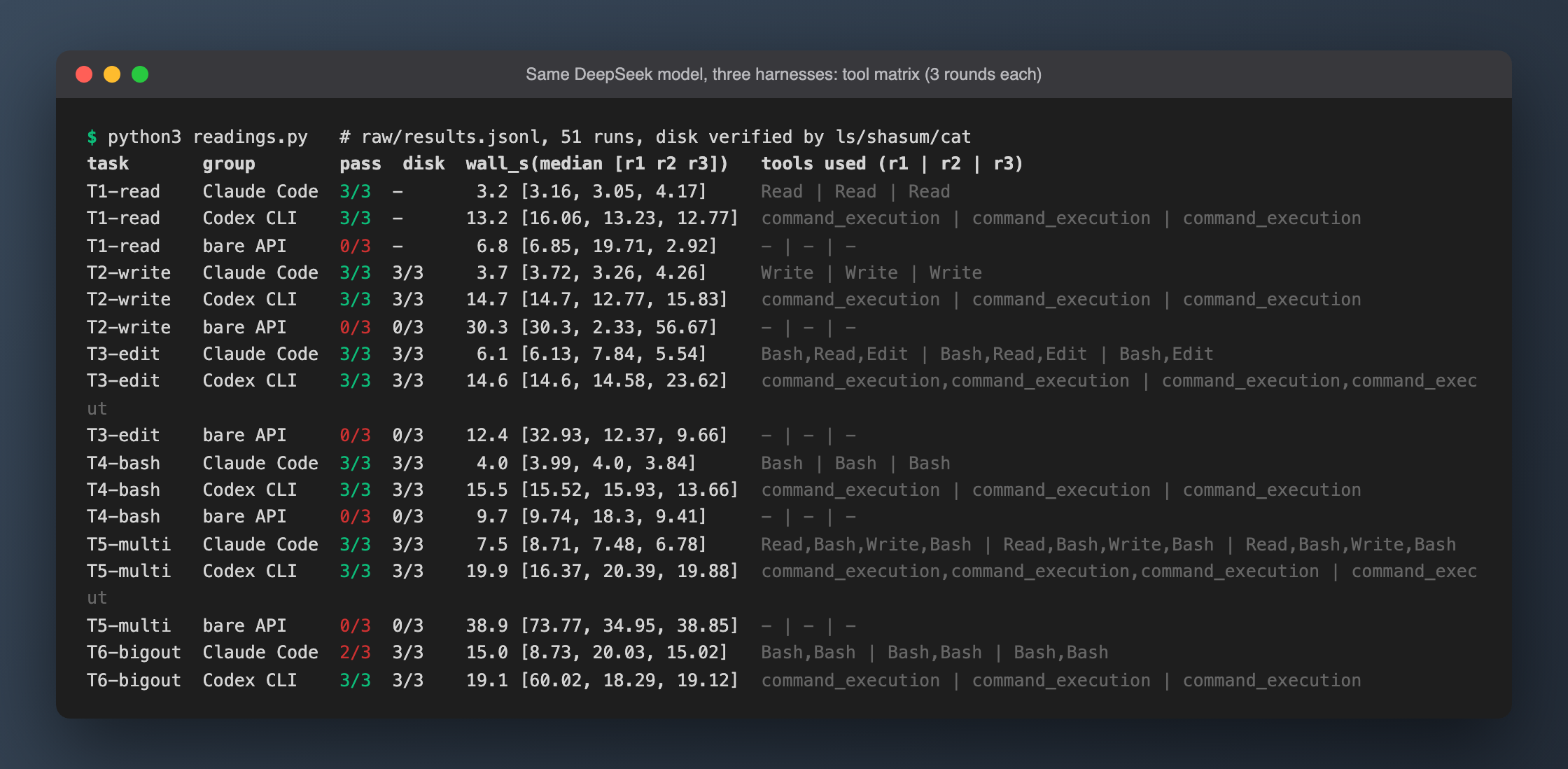
DeepSeek Harness Test: One Model, Three Harnesses — Claude Code 15/15, Codex CLI 15/15, Bare API 0/15 (and 5 Fake "Done"s)

DeepSeek Harness Test: One Model, Three Harnesses — Claude Code 15/15, Codex CLI 15/15, Bare API 0/15 (and 5 Fake "Done"s)

Same DeepSeek model (deepseek-v4-pro), three harnesses, five tasks (read / write / edit / run a command / multi-step), three rounds each, every side effect checked on disk. Claude Code on DeepSeek's Anthropic endpoint: 15/15, median 4.17s, ¥0.159 per task. Codex CLI 0.157.1 on the Responses endpoint: 15/15, median 15.52s, ¥0.022 per task — one seventh. Bare chat/completions: 0/15, and 5 of those rounds replied DONE or EDITED with nothing on disk. The differences are the harness: DeepSeek partitions its prompt cache by metadata.user_id, so every `claude -p` pays ~15K uncached tokens; Codex has no file tools and does everything through shell; on HTTP 500 Claude Code retries 10 times over ~175s while Codex quits in ~25s, and on 429 Codex doesn't retry; on 120KB of output Claude Code shows the first 2KB, Codex head + tail. And wire_api = "chat" is gone in Codex 0.157.1 — use responses.

claude-codeprompt-caching+6
hands-onSep 28, 202613 min
54

Dev Breakfast · 2026-09-28

Today's headline: GitHub made CSS even more verbose, but server-side rendering sped up by 55%. Plus 4 more: NeoVim changed the undo file format, deleting Vim's undo history; Codex spawned 826 subtasks for a single UI check, with a bill of $78,000; and more.

daily-intelSep 28, 20269 min
114

Published by Magic Tools