From Opus 4.8 to Claude Fable 5: Why My Tool Calls Don't Fail Anymore
First, two clarifications: first, this is not a benchmark from an evaluation institution, but my experience from working continuously in Claude Code for several days, cross-verified with Anthropic's official documentation; second, this article itself was written and published by Fable 5—from reading materials, writing, calling the publishing API, to online verification, the entire chain of over a dozen tool calls never broke. This can be seen as a kind of performative self-proof.
The Problem I Encountered: Opus 4.8's Tool Calls Always Fall Short
First, let me clarify what I mean by "tool call issues"—it's not about errors. Opus 4.8's tool call format rarely makes mistakes; the problem lies at the behavioral level:
- Not calling tools when it should: Clearly, it should search, read files, or delegate subtasks, but it chooses to answer based solely on existing context.
- Repeated confirmations before calling: For an operation that should obviously be done directly, it stops to ask "Shall I...?", wasting several rounds of back-and-forth.
- Long tasks breaking halfway: For a task chain of over a dozen steps, after some middle step, it suddenly starts summarizing and stops doing the remaining work.
If you have similar experiences, here's some good news: this is not your imagination—Anthropic's own migration documentation explicitly acknowledges this. In the official migration guide for Opus 4.8, there's a dedicated "behavioral drift" section, which essentially states:
- "More conservative use of capabilities requiring explicit decisions"—file memory, sub-agent delegation, custom tools, won't be proactively used unless very certain (the official term is under-utilization).
- "More deliberate—more often stopping to ask"—the official admits that it tends to pause and ask even on minor decisions, and even provides recommended prompts to suppress this behavior.
- The previous Opus 4.7 documentation also states "defaults to using tools less."
In other words, the Opus family in recent generations has been tuned towards "caution and restraint," with the side effect being the "falling short" feeling in agentic scenarios. The official remedy is to add various explicit instructions about "when to call tools" in the system prompt—it works, but it essentially shifts the model's judgment to the prompt writer.
What is Fable 5
First, let's present the official facts (from Anthropic's official documentation, not second-hand sources):
| Item | Fable 5 | Opus 4.8 (Comparison) |
|---|---|---|
| Positioning | The strongest publicly released model, aimed at the hardest reasoning and long-horizon agentic work | The strongest Opus-tier model |
| Context | 1M tokens (default is maximum) | 1M tokens |
| Max Output | 128K | 128K |
| Price | $10 / $50 per million tokens (input/output) | $5 / $25 |
| Thinking | Always on, cannot be turned off | Can be on or off (adaptive) |
Two numbers are worth pausing for: the price is exactly double that of Opus 4.8, and thinking is permanently locked on. These two are actually intertwined—it's designed as a model that "thinks through every step before acting," and you're paying for that.
What Fable 5 Specifically Fixed in the Official Documentation
Addressing the three pain points of Opus 4.8, Fable 5's official documentation almost responds point by point:
1. Long-horizon execution is a core capability, not a bonus. The official description is "SOTA for long-duration autonomous agentic work"—complex refactoring, overnight coding tasks, without needing human correction midway. Running for over ten minutes per request is by design. This directly corresponds to the "long tasks breaking" issue.
2. Progress reporting has been specifically trained. The official documentation has a very firm statement: requiring the model's every progress claim to correspond to tool call evidence in the current session, with training results that "nearly eliminate fabricated status reports." This means when it says "done," it's likely actually done—this solves the most annoying issue of AI coding tools: "saying it's changed but actually not changing."
3. Parallel sub-agents shift from "needs suppression" to "recommended use." Best practices for previous models were to limit sub-agent usage (due to unreliability), but Fable 5's official guide recommends "frequently use sub-agents, asynchronous communication"—the capability is reliable enough to flip the direction.
4. Prompts should be "de-instructionalized." This is the most interesting: the official explicitly states that step-by-step detailed prompts written for older models actually degrade output quality when used with Fable 5, recommending only stating goals and constraints, not listing steps. This is indirect evidence of a step up in the model's autonomous judgment—it no longer needs you to lay the path.
What I Actually Had It Do These Days
Quoting documents alone is armchair strategy; let's talk about real workloads. These days, I used Fable 5 in Claude Code to continuously do these things:
- Wrote and published three articles to my own website—each with a complete chain: reading project documentation for materials → writing → stripping frontmatter → encoding JSON in the shell with jq → calling the publishing API → switching browser UA to bypass my own website's anti-bot for online verification (it discovered the 403 was our custom bot blocking, switched UA to re-verify, and didn't get stuck asking me).
- Reading images and extracting data: Gave it two screenshots (one from Linode console, one from fast.com speed test), it read "2012-07-13 created" (automatically calculated as used for 14 years), "unloaded 150ms / loaded 177ms", and wrote the insight "only 27ms increase under load is the gold standard for GIA" into the article—all numbers matched the images.
- Instant absorption of mid-interruption: While it was editing an article, I inserted a message "monthly price is $16.9", it merged the ongoing edit with this correction without dropping either.
- Active verification after each publication: Not just announcing success after publishing, but curling the online page, grepping for key content, and reporting only after getting evidence.
The entire process had zero tool call format errors, zero "saying it would do but didn't", and zero chain breaks. For the same tasks with previous models, I'd expect to manually prompt "continue" at least two or three times.
An even more extreme sample: on another computer, I had Fable 5 generate book content themed around "The Art of War"—a single task running continuously for over 2 hours, without human intervention, and the quality remained online afterward—no degradation in writing, no skimping in later sections, no premature summarization. This is exactly the "overnight coding tasks without human correction" mentioned in the official documentation, adapted for content production: long-horizon consistency isn't marketing fluff, it truly can sustain two hours without breaking. With previous models, I'd default to monitoring such long-duration tasks, prompting occasionally; this time, it was truly "hand it over and go do other things."
The usage panel can attest this wasn't superficial:
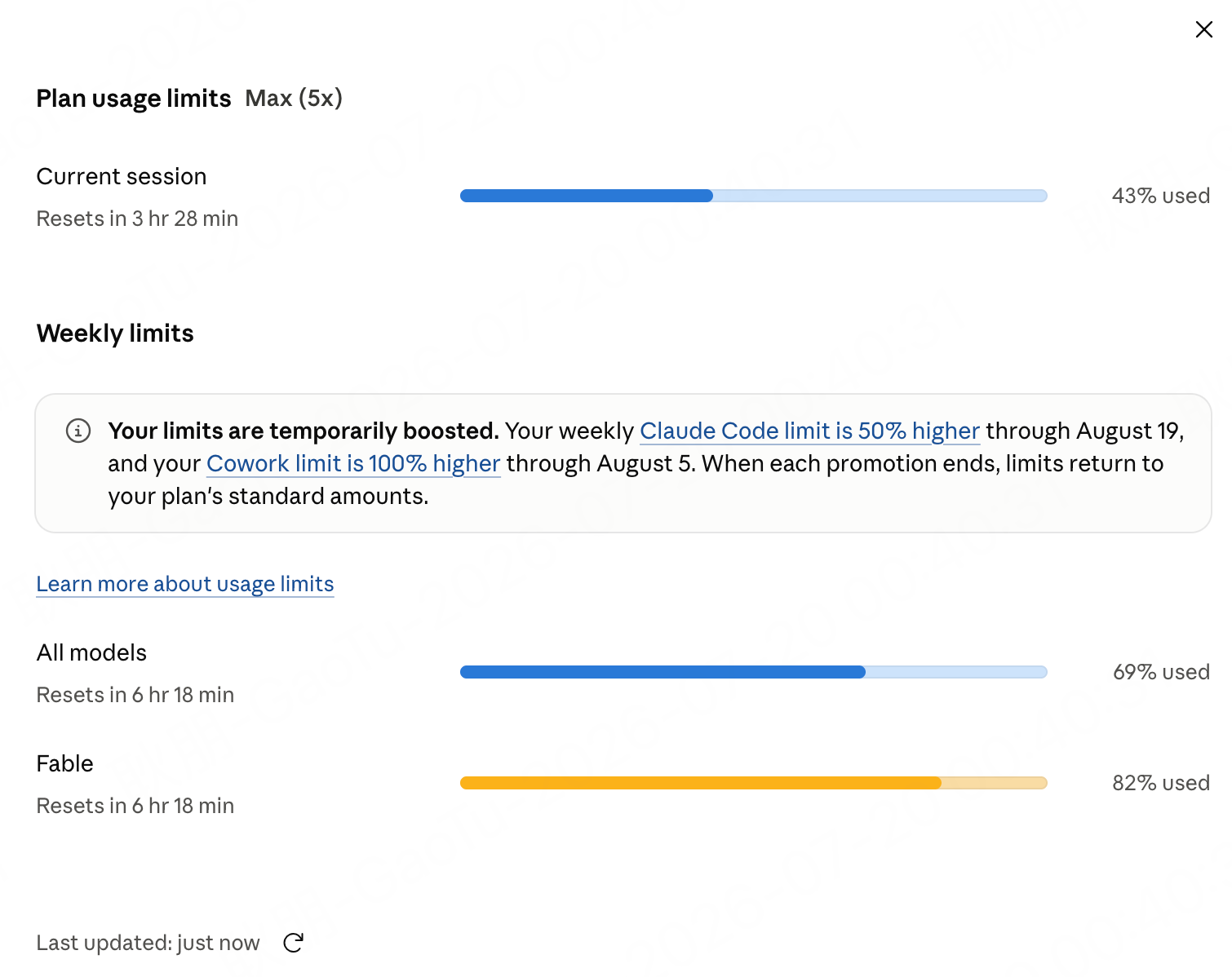
For subscribers, a practical note (also visible in the screenshot): in the Claude Max subscription, Fable has an independent weekly quota separate from "All models"—this week, my Fable usage hit 82%, while all-models was only 69%, meaning heavy Fable use will first hit its independent limit rather than consuming the entire subscription quota. When planning long tasks, you can watch this orange progress bar.
Technical Explanation for the Experience Difference (My Inference, Not Official Conclusion)
Combining the official documentation and my experience, I believe the core difference is: Opus 4.8's "tool call issues" are essentially decision problems, not capability problems—it can call tools, but it's tuned too conservatively on "whether to call"; whereas Fable 5, with thinking always on, has a complete internal reasoning phase before each action, thinking through "whether to call a tool, which one, and what to do if it fails" before proceeding. Coupled with specific training on long-horizon consistency, the chain naturally doesn't break easily.
One supporting point: the official documentation states that Fable 5 actually performs worse with "over-instructionalized prompts"—indicating that its behavior is primarily driven by its own reasoning, rather than being led by prompts. This is the exact opposite personality of Opus 4.8, which "needs prompts spoon-fed to it before it's willing to call tools."
When Is It Worth Paying Double the Price?
To be honest, Fable 5 isn't the answer for all scenarios:
Worth using: Long-horizon agentic tasks (large refactoring, multi-step automation pipelines, tasks requiring dozens of tool calls), hour-scale long-form content generation (books, series manuscripts that require consistency throughout), high-trust scenarios where "saying it's done means it's done," and complex open-ended tasks where you're too lazy to write detailed prompts.
Not necessary to use: Daily Q&A, single-file small edits, translation summaries, and other one-off tasks—Opus 4.8 or even Sonnet 5 are more than sufficient, at less than half the price. Thinking always on also means higher latency for simple tasks compared to other models—using a sledgehammer to crack a nut and waiting longer.
My usage: I keep Fable 5 as default in Claude Code (/model fable command to switch), because most tasks I give it are long chains like "read a bunch of materials → do a series of tasks → verify → deliver," which hit its strengths exactly. If your usage is mostly quick Q&A, don't follow the trend.
FAQ
Q: How do I enable Fable 5 in Claude Code?
Input /model fable and press Enter; it will save as default. To switch back, use /model opus or other model names.
Q: Is it slower than Opus 4.8? Single responses may feel more "deliberate" due to thinking always on, with noticeable wait times for simple questions. But for long tasks, total time is often actually shorter—because you don't need to push it midway, correct errors, or retry; the time cost of running through once is far less than three chain breaks.
Q: Any pitfalls when using it via API?
A few official differences: don't pass the thinking parameter (it's always on; explicitly passing disabled will cause a 400); doesn't support assistant prefilling; requires the account to have 30-day data retention enabled (zero-retention configuration will cause a 400); the safety classifier may return refusal, and the official recommends configuring a fallback to Opus 4.8 by default. Before writing code, it's advisable to review the official migration guide.
Q: Could the "tool call issues" just be due to my poor prompting? It might improve but only symptomatically. The official remediation for Opus 4.8 is to add prompts (specifying "when to call" in system prompts and each tool's description), which is indeed effective. But this patches the model's conservatism; Fable 5 solves the decision quality at the model itself. If the budget allows, switching models is less hassle than tweaking prompts.
Q: Was this article really written by Fable 5 itself? Yes. Materials came from real project documentation and official API docs, and the entire chain of writing, publishing API calls, and online verification was completed by it in Claude Code—I only gave direction commands and fact corrections. The fluency you're reading now can be taken as a sample of its writing ability.